


Most ecosystems produce startups. A few produce repeatable outcomes.
Türkiye belongs to the second category.
The global narrative often focuses on headline moments a unicorn, a large exit, and a funding spike. But those are outputs. What matters is the system underneath.
If we want to understand Türkiye’s role in global gaming, we need to examine how that system was built and why it continues to compound.
Phase I: Survival Built the Operating Culture
Before there were unicorns, there was scarcity.
Capital was limited. Local publisher presence was weak. International credibility was low. Studios could not afford long creative cycles or vanity launches. Games had to monetize early or teams shut down.
That constraint shaped behavior in ways capital-rich ecosystems rarely experience.
Founders internalized:
- Unit economics before brand narratives
- Retention discipline before scale
- Fast kill decisions over emotional attachment
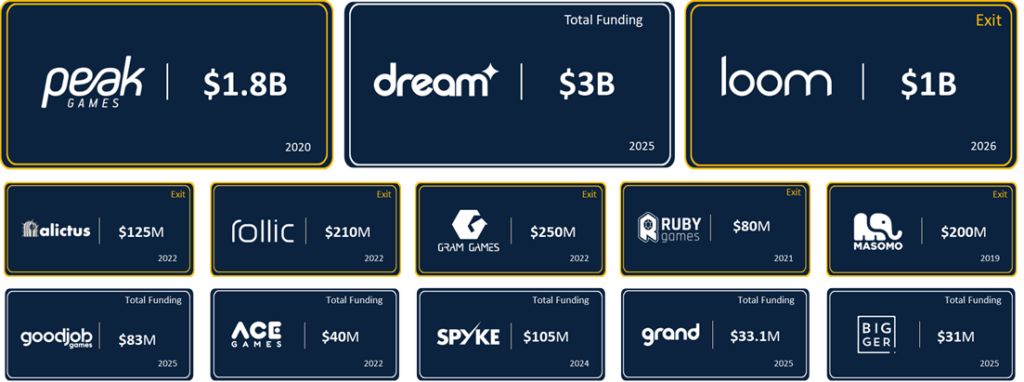
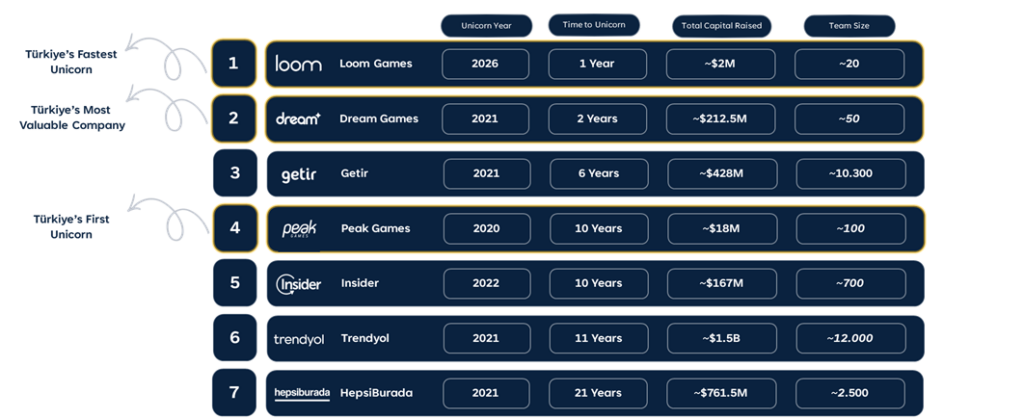
When Peak Games sold to Zynga for $1.8 billion, it wasn’t simply a liquidity event; it validated a model of small, analytically driven teams building globally competitive products from Istanbul. What followed was not random: Dream Games scaled into a category leader, and Loom Games became one of the fastest-scaling unicorns in the market.
Today, Istanbul hosts more than 740 active startups and ranks as Europe’s second-largest mobile gaming hub after London, while Ankara has emerged as another meaningful center. But the numbers are downstream, and the culture is upstream, because constraint became the operating system.
Phase II: Policy Reduced Structural Friction
Operating culture alone does not create an ecosystem. It must scale. Türkiye’s government did something rare: it aligned policy with industry mechanics.
Studios benefit from:
- Direct subsidies for user acquisition
- Refunds on platform and distribution fees
- Support for analytics and marketing tools
- Funding for localization and international expansion
- Meaningful tax advantages
- Talent recruitment programs
This is not generic startup support, as it directly addresses the cost centers that define gaming economics, leading to a second-order effect where scaling risk decreases. When UA experiments are partially subsidized, studios can test more aggressively; when localization and distribution costs are reduced, global expansion happens earlier; and when tax advantages extend runway, founders maintain ownership longer.
Ultimately, the combination of disciplined operators and friction-reducing policy created repeatability, which is when ecosystems transition from emerging to structural.
Phase III: AI Compresses the Advantage of Scale
The next chapter is technological. AI-native production tools are reducing asset creation costs, shortening development cycles, and automating parts of live-ops and testing. While many assume this shift benefits large publishers with deep capital reserves, we see a different outcome: AI compresses the advantage of size. Production leverage moves toward execution speed, not headcount, meaning ecosystems already optimized for small, high-output teams gain disproportionate benefit. Türkiye’s studios were built to operate lean, so AI does not disrupt that structure; it enhances it.
When a 20-person team can achieve output previously requiring 60, capital efficiency improves. Furthermore, when iteration cycles accelerate, data feedback tightens, and when global distribution remains digital and borderless, talent cost arbitrage becomes meaningful again.
The inflection point is not just about tools; it is about who is culturally prepared to use them.
Phase IV: Gaming DNA Expands Beyond Games
The final layer is often overlooked. Mobile gaming trained a generation of Turkish founders in engagement economics, session design, behavioral loops, monetization architecture, and A/B test, and these capabilities are portable. We are increasingly seeing gaming-native operators build playable consumer apps, gamified fintech products, and interactive media platforms, as engagement literacy becomes a competitive advantage in sectors far beyond entertainment.
In a fragmented attention economy, retention expertise is strategic infrastructure. Many ecosystems produce strong engineers, but fewer produce operators fluent in large-scale behavioral design, and that fluency compounds across verticals.
The Structural Loop
Türkiye’s gaming rise is not a moment. It is a feedback loop:
- Scarcity built discipline.
- Discipline produced exits.
- Exits created operator density.
- Policy reduced friction.
- AI amplifies lean execution.
- Engagement expertise spreads across sectors.
The ecosystem now compounds from multiple vectors simultaneously. Markets rarely announce when they stop being opportunistic and start being systemic; they simply continue producing outcomes long after observers assume the peak has passed.